> For the complete documentation index, see [llms.txt](https://docs.cwicly.com/llms.txt). Markdown versions of documentation pages are available by appending `.md` to page URLs; this page is available as [Markdown](https://docs.cwicly.com/blocks/query/query-editor.md).
# Query Editor
The Query Editor helps you to construct and modify a Wordpress Query using a structured format in which you can interactively select components.There are 4 main Query types : Post Types, Terms, Users and Products.
You can also export your Query elsewhere by copying and pasting the generated code.
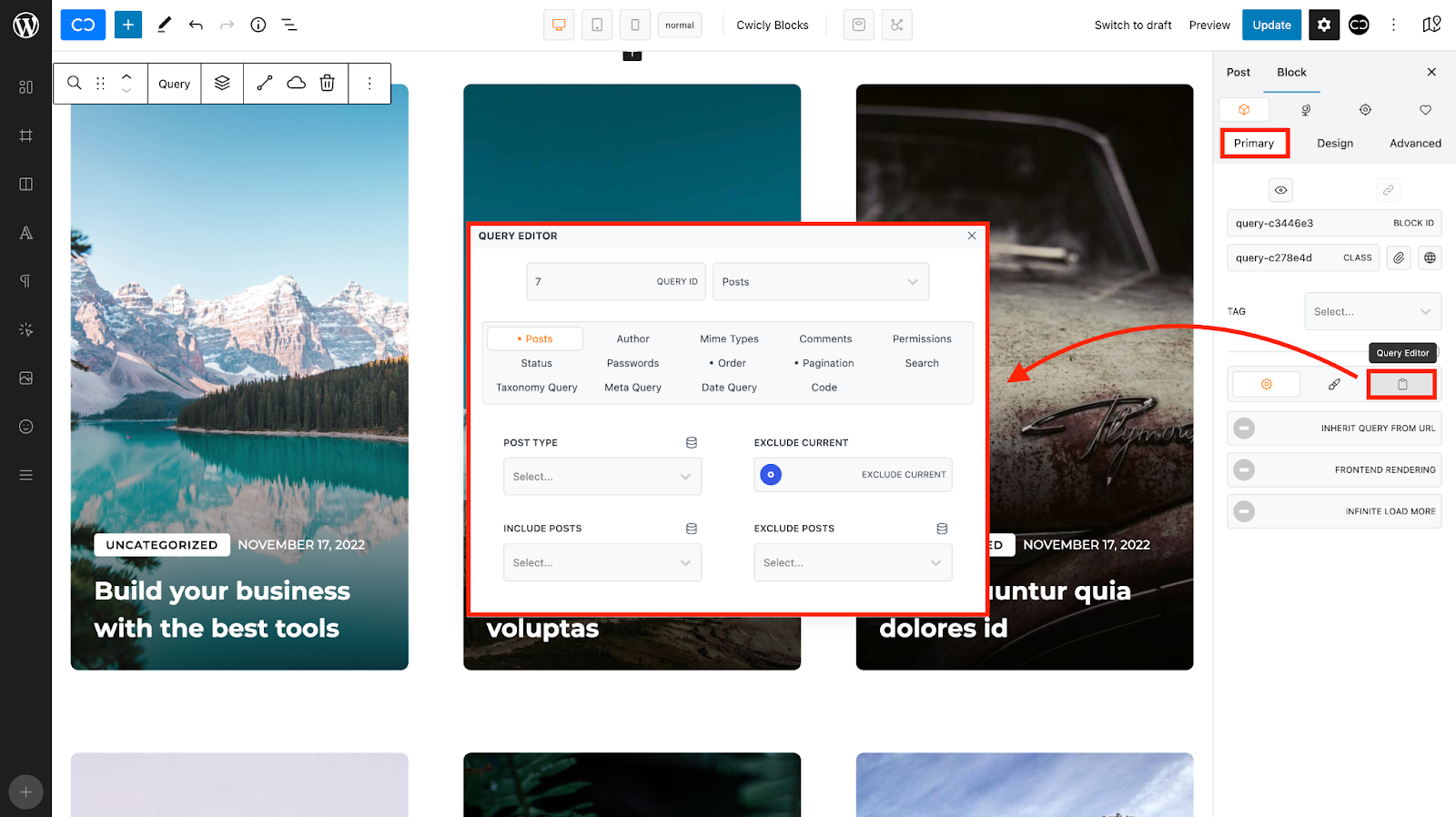
Open
1. Click on the ➕ icon to open the Inserter Panel
2. Select `query` block
3. Open the Block Inspector
4. Navigate to the Primary tab
5. Find Query Builder icon
6. Click to open Query Builder Modal
## Query ID
The Query ID defines the unique identity of a particular query.
It is used for linking to a filter block.
{% hint style="info" %}
The Query Editor has 4 query types:
* Posts
* Terms
* Users
* Comments
{% endhint %}
## Dynamic
{% hint style="warning" %}
Every setting in the Query Editor can have a dynamic source (meaning the data updates automatically), for any query type.
{% endhint %}
## Posts
Posts are time specific pieces of content posted on your website. They can be thought of as articles or updates that you share with your readers.
{% hint style="info" %}
By default, posts are listed in reverse chronological order (this can be changed).
{% endhint %}
{% content-ref url="/pages/jiXXbalor6VbodOeqo3T" %}
[Posts](/blocks/query/query-editor/posts.md)
{% endcontent-ref %}
## Terms
Terms refer to the items in a taxonomy and includes: Taxonomies, Terms, Search, Include/Exclude, Descendants, Order by Order, Pagination, Count, Return Fields, Meta Query, Code.
{% content-ref url="/pages/WjQRxZlf85iLOzi71nQf" %}
[Terms](/blocks/query/query-editor/terms.md)
{% endcontent-ref %}
## Users
Users are visitors who have login access to your site.
{% content-ref url="/pages/KbFz81BUVpwRkIKZ43C3" %}
[Users](/blocks/query/query-editor/users.md)
{% endcontent-ref %}
## Comments
The Comments property allows you to Add comments to your search query in order to add context for users who may want to use or edit your queries at a later date.
{% content-ref url="/pages/k1kQOBOEf1Qo9U3S4rW8" %}
[Comments](/blocks/query/query-editor/comments.md)
{% endcontent-ref %}